



Searching...
The starkness of Namibia ghost towns is where shifting desert dunes whisper secrets of the past, and eerie skeletons of shipwrecks burst out of the sand and sea. Within this desolation lie the intriguing stories that have maintained their mystique for generations, drawing travellers from across the globe.
Whether you believe in the supernatural or are simply captivated by the dark history of Namibia ghost towns, the haunting beauty of this Southern African country offers a glimpse into a bygone era. From the sand-choked hallways of Kolmanskop to the rusted ribs of shipwrecks, these sites are a must-see for the spook-loving road-tripper.
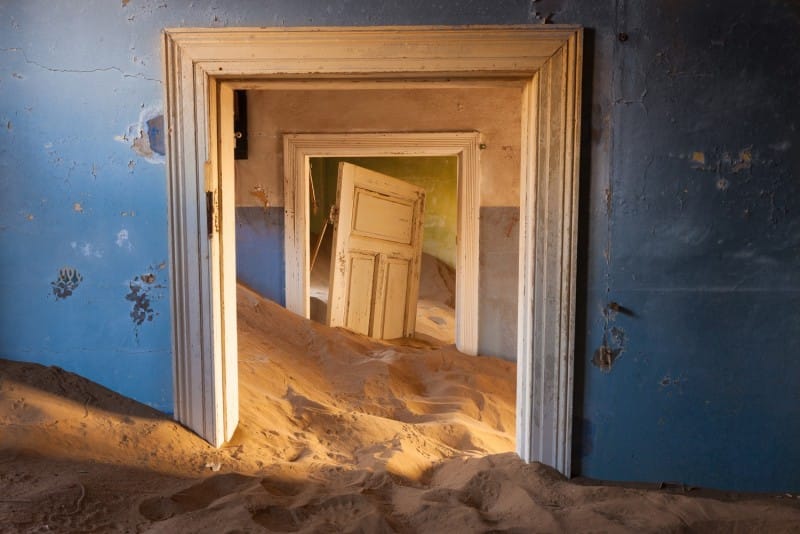
Perhaps one of the most famous abandoned places in Namibia, Kolmanskop (Coleman’s Peak), was once a small but wealthy mining village. Situated roughly 10 km from the coastal town of Lüderitz, this Namibia ghost town is literally returning to the sand from whence it came.
The history of the town is a strange and painful one. In 1908, Namibian railway worker Zacharias Lewala was working on the tracks when he saw some stones shining in the light. Those shining rocks turned out to be diamonds. Once the news spread, hordes of prospectors descended on the area, and by 1912, the town was booming.
German authorities wanted more control over the town and declared the area a Sperrgebiet, or restricted zone, in 1908. This forbade ordinary people from prospecting – reserving it only for a single Berlin-based company. Indigenous people, who had been displaced from their land, were employed as labourers and forced to live in barrack-like compounds for months at a time.
By the time the first World War rolled around, the diamond mines had already begun to run dry and by the 1920s, the once-thriving area was in severe decline. In 1928, the town’s demise was hastened when the richest diamond fields ever known were found on the beach terraces to the south. Townspeople left in droves, abandoning their homes and possessions and by 1956, Kolmanskop was a ghost town.
Today, its buildings sit abandoned as they’re slowly being reclaimed by the desert. Knee-deep sand fills the once-quaint miners’ cottages. It’s widely considered the most haunted town in Namibia, with many claiming to hear disembodied voices, whispers, or phantom footsteps echoing through the decaying hallways. Although these might be the footsteps of a brown hyena, as they’re known to shelter in the town’s abandoned buildings.
Traveller Tip: Because Kolmanskop is still in a restricted diamond area (Sperrgebiet), you must arrange a permit to visit. It’s located just 10 km from Lüderitz, so it’s easily accessible by car.
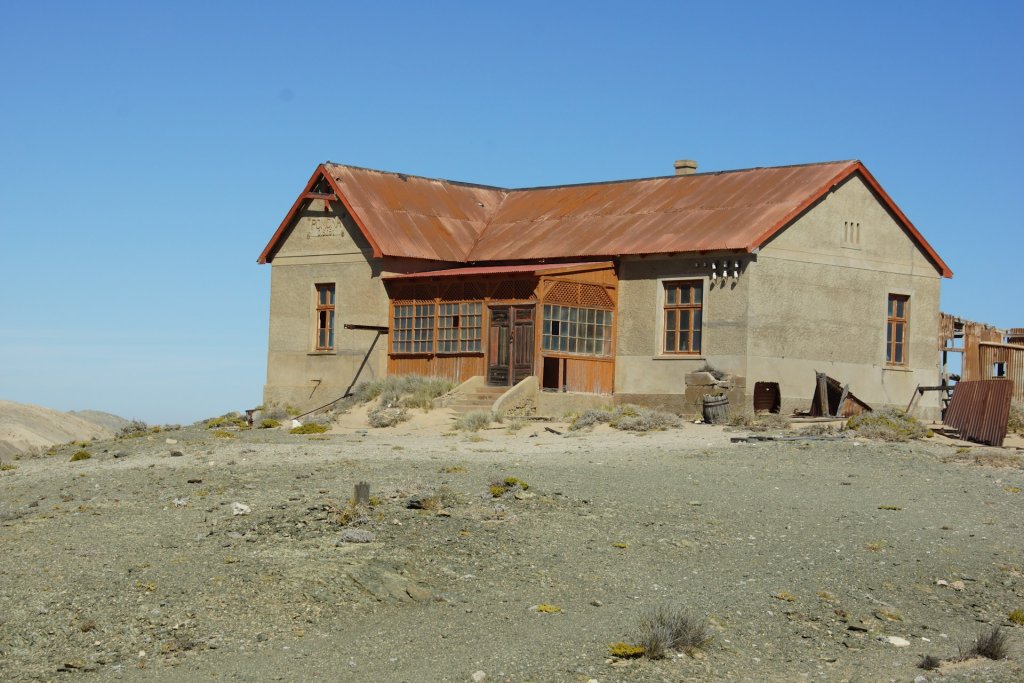
Another one of the ghost towns in Namibia, Pomona was once home to one of the most prolific diamond mines in the world. If Kolmanskop is the more famous of Namibia’s ghost towns, Pomona is its wilder, more remote, and perhaps even more haunting relative.
In its heyday, diamonds were said to be so plentiful that you could walk around and pick them up with your bare hands. The town generated over one million carats of diamonds between 1912 and 1914.
This incredible wealth led to a rapid boom, and at its peak, the town was home to about 500 people. Much like the Kolmanskop ghost town, the town’s existence relied on the extraction of diamonds. Once the richest deposits were exhausted, the town collapsed.
Today, it sits abandoned, where decaying buildings and rusted machinery are slowly being consumed by the desert sands. Located deep within the Sperrgebiet, about 15 km south of Elizabeth Bay, it remains one of the most exclusive and atmosphere-heavy abandoned places in Namibia.
It’s somewhat of a hidden gem – at least when it comes to ghost towns. Unlike Kolmanskop, which sees a lot more visitors, Pomona sits in a state of advanced, beautiful decay. One of its most recognisable structures, the schoolhouse, still has an old chalkboard and desks, now surrounded by encroaching dunes.
The cemetery also remains intact and is probably the most haunted spot in town. It sits on a windswept hill with iron crosses and wooden markers that have been sandblasted so much that the names of their occupants are no longer visible.
Important to know: Because Pomona is located within a restricted diamond mining area, you cannot simply drive there in your own vehicle. Access is granted only via authorised tour operators from Lüderitz. These are typically full-day 4×4 excursions. You must apply for a security permit at least 10 days in advance, providing a copy of your passport or ID.
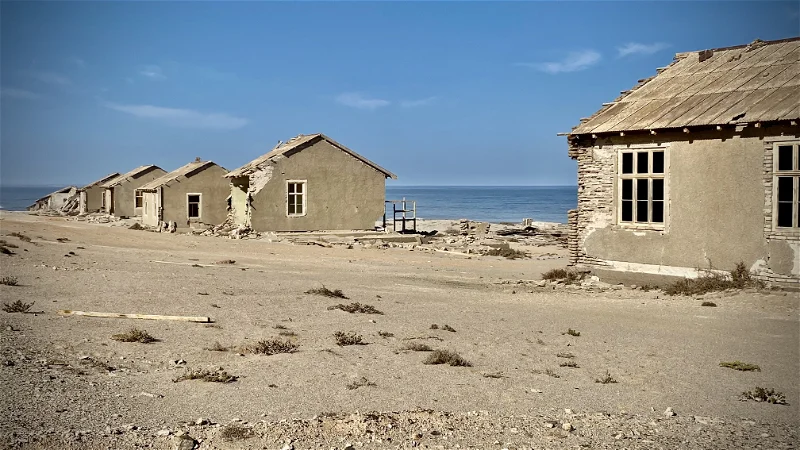
While the Kolmanskop ghost town is the most famous, Elizabeth Bay (or E-bay, as it’s locally known) is its raw, industrial counterpart. Located roughly 25 km south of Lüderitz, this ghost town in Namibia offers a more unfiltered view of Namibia’s diamond history. It lies very close to the ocean and is prone to being engulfed by coastal fog, making for some haunting photo opportunities.
The town was built in the early 1920s as diamonds at Kolmanskop began to run dry. It was a state-of-the-art settlement with a casino, an entertainment hall, and a massive diamond processing plant. However, the Great Depression of 1929 crushed the global diamond market, and the town was abandoned by 1948.
After Namibia’s independence, a modern mine was built on the site. It operated on and off until the early 2000s. In 2009, the mine was operating at a N$76 million loss and was sold to Sperrgebiet Diamond Mining in 2020. As of today, active diamond mining at Elizabeth Bay is in severe turmoil and essentially halted, with rumours that it’s not making much of a profit (if any at all).
While Kolmanskop is known for its sand-filled houses, Elizabeth Bay is defined by its industrial decay. You can explore the skeletal remains of massive processing plants, featuring rusted gears, conveyor belts, and crumbling brickwork that looks like it’s being beaten by the salty sea air. Some of the residential buildings still feature floor-to-ceiling murals (depicting flocks of geese or palm trees), painted by homesick residents to mimic the European landscapes they left behind.
Fun fact! Kolmanskop as well as Elizabeth Bay’s eerie, end-of-the-world aesthetic has caught the eye of many, including Hollywood. If you’re a fan of the Fallout TV series, you might recognise it as one of their film locations.
Important to know: Just like the Pomona and Kolmanskop ghost towns, Elizabeth Bay is located within the Sperrgebiet and you will need to book a tour to explore it. You must provide your passport details to a tour operator at least six working days in advance so they can secure your police clearance and Namdeb permit.
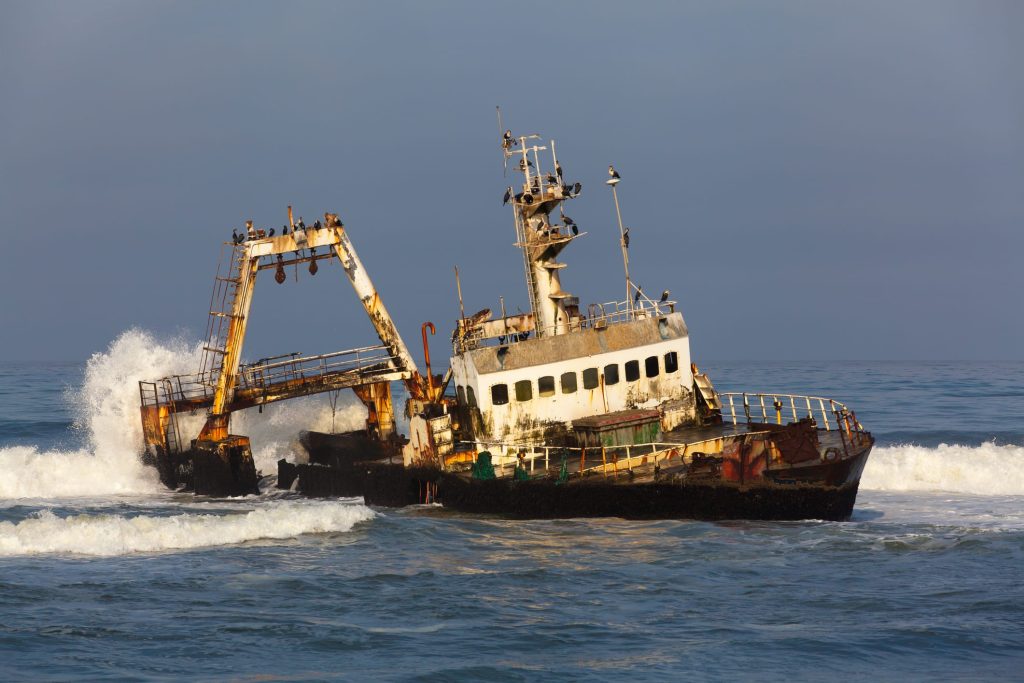
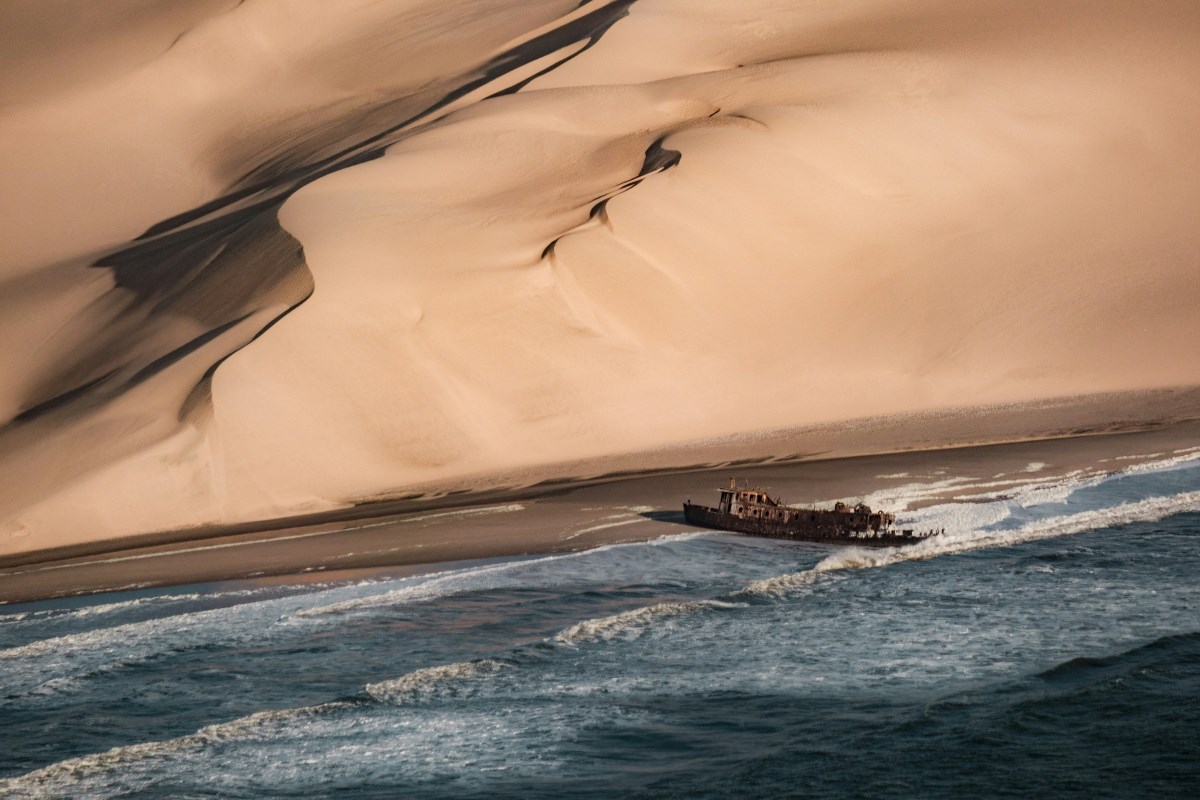
While not strictly a ghost town, the Skeleton Coast shipwrecks make for an excellent addition to your tour of Namibia. This eerie stretch of coast extends north towards Angola and remains notorious for its unforgiving Atlantic waters and thick fogs, which have led many ships to an untimely end. Their remains still lie in the ruthless dunes of the Namib Desert, where the sand meets the sea.
Indigenous tribes have aptly named the desert “The Land God Made in Anger”, while early Portuguese explorers called it “The Gates of Hell”. And it’s easy to see why. Many Skeleton Coast shipwrecks have now disappeared below the sands – some far away from the shore, as the ever-shifting desert reclaims the sea.
Notable wrecks here include the Dunedin Star and Eduard Bohlen. While most shipwrecks are found at the water’s edge, the Eduard Bohlen appears to be sailing across a sea of sand. It currently sits about 400 to 500 metres inland, completely surrounded by the dunes of the Namib Desert. It was a cargo ship that ran aground in a thick fog near Conception Bay while on a voyage from Swakopmund to Table Bay in 1909. To see it, you must join a specialised 4×4 tour or take a scenic fly-in safari, as the wreck lies in a remote, protected area.
The nearby Dunedin Star is another one of the famous shipwrecks off Namibia’s coast. She was a British refrigerated cargo liner and served in the Second World War. In 1942, the ship left Liverpool for Egypt, via Saldanha Bay. On the way there, the ship struck something underwater along the Skeleton Coast. To prevent the ship from sinking in deep water and to save those on board, Captain Gaunt ran the vessel aground in heavy surf on the desolate Namibian shore.
While some remained on the ship, 63 people (including women and children) were ferried through the violent surf to the beach, where they found themselves stranded in the harsh desert. After more than a month of starvation and exposure, the survivors were eventually rescued in December 1942. Today, parts of the ship still remain visible – about 250 metres from the high-water mark.
Traveller Tip: This is a journey that requires a sturdy vehicle. Most travellers access the southern section via Henties Bay. For the northern reaches, consider a fly-in safari or a guided 4×4 expedition to safely navigate the treacherous sands.
Navigating the vast distances between these sites requires preparation. The terrain ranges from salt flats to deep desert sand, making reliable transport a priority. To truly experience the wonder of Namibia’s ghost towns, you should consider hiring a 4×4 vehicle. A high-clearance vehicle is essential for the corrugated roads leading to the Skeleton Coast and the sandy outskirts of ghost towns.
Namibia’s ghost towns are not just spirits; they are the physical remains of ambition and industry, and the oldest desert on Earth is slowly erasing them. Whether you’re hunting for famous shipwrecks off Namibia’s coast or exploring a silent ballroom in Kolmanskop, the experience is one of profound, quiet adventure.
Speak to one of our experts today to start planning your haunted Namibia road trip adventure!



Typically responds in under 15 minutes